Another controversy has arisen over the display of the Ten Commandments in a courtroom. This time it is from Ohio, and one unusual twist is that the judge who occupies that courtroom designed a display that uses the Ten Commandments. He makes a comparison between absolute laws, such as the Commandments, and relative laws. That could be interesting, but I haven't seen it personally and it is not the point of this post.
In the first place, it does indeed sound like this particular is not a statement that would be endorsed by or displayed in most churches. So it may be hard to call it a religious display, as in establishing a church or even endorsing a particular religion. But even that is not my main point.
Many people claim that the founders based our laws and Constitution on the Ten Commandments. And there are statements by the founders that support such a view. Some are covered in this blog. There are also many who way that such is not the case, and they have quotes to support their view.
One of those views is bound to be right. Either the founders did or did not base our laws on the Ten Commandments. If they somewhat based the law on the Commandments, that would support the "yes" side and validate displays of the Commandments almost anywhere.
Let's pretend for a minute that the founders really did base the law on the Ten Commandments. That could be compatible with the fact that they are displayed on and in the Supreme Court building. IF this is true, and given the words of our First Amendment and decisions of our Supreme Court, would a Ten Commandments display in a courtroom still be unconstitutional? Logic would say "no." So should not their constitutionality be based on the words of the Constitution? That is our controlling document and it was written in a way that was intended to be understood by any reasonably educated citizen.
Read more about this particular controversy here:
http://findroom219.wordpress.com/2010/01/29/philosophy-poster-containing-ten-commandments-gets-judge-back-in-spotlight/
Saturday, February 20, 2010
Ten Commandmants


Monday, January 25, 2010
Thomas Jefferson's Proudest Accomplishments
I have mentioned Thomas Jefferson many times in this blog. Probably his most common mention here is because he once used the phrase "separation of church and state" in a letter, and that phrase somehow has become our de facto guide to the meaning of the Constitution's First Amendment religion clauses. But does it really mean what some people take it to mean? Did Jefferson mean that there can be no governmental recognition or accmomodation of religion? Read on...
Of course, Thomas Jefferson is know for a great many things. But what did Jefferson himself consider his greatest accomplishments? Certainly not the letter mentioned above. At the age of only 33, he penned the words of the Declaration of Independence. Now that is definitely one for the history books! He was proud enough of that work to have it chiseled into his headstone. Sharing the honor (after the Declaration) is his authorship of the Statute of Virginia for Religious Freedom and his role as father of the University of Virginia.
The statute was a law that, among other things, specified a fine for working on the sabbath.
And consider his work as president of the University of Virginia (a state institution).
The following was previously posted as Jefferson's Actions Speak Louder than a few of His Words:
In order to accommodate and perpetuate the religious beliefs and practices of students at the university, he recommended that students be allowed to meet on the campus to pray, worship, and receive religious instruction, or, if necessary, to meet and pray with their professors.
He provided in his regulations for the University of Virginia that the main rotunda be used for religious worship under the regulations allowed to be prescribed by law.
He proposed that all University of Virginia students be required to study as a matter of ethics "the proofs of the being of a God, the creator, preserver, and supreme ruler of the universe, the author of all relations within morality, and of the laws and obligations these infer."
See a photo of Jefferson's gravestone here:
Thomas Jefferson’s Greatest Achievement
Sunday, January 3, 2010
What Items to Embed in a Cornerstone...
I'm not sure that embedding significant items in cornerstones is as common as it once was. At one point it was often done on significant (and not-so-significant) buildings.
One of the former would be the U.S. National Archives building in Washington, D.C. President Herbert Hoover participated in the ceremony. The ceremony was considered important enough that President Hoover moved the ceremony earlier (before it actually was time to lay the cornerstone) so his name could be on it.
I'm sure most who read this blog know that there are many voices today proclaiming that our nation has no significant religious or Christian roots. Someone forgot to tell President Hoover and the others who set up this ceremony, apparently, because the object placed in the cornerstone included:
- A Bible
- copies of the Declaration of Independence and the Constitution
- an American flag
- copies of the public acts authorizing the construction of the building
National Archives Website
Saturday, December 26, 2009
The Walls Are Singing
Taking a tour of Washington, D.C. can be an educational experience for any number of reasons. One reason is to learn how much you see religious references in some of our most famous buildings and monuments. In walking through the Cox corridors of the U.S. Capitol, for example, you find these words:
"America! God shed his grace on Thee, and crown thy good with brotherhood from sea to shining sea!" - Katharine Lee Bates
Prayer Room
"Annuit coeptis" (God has favored our undertakings)
"Preserve me, O God: for in thee do I put my trust." —Psalm 16:1
Senate Chamber
Over east doorway: "Annuit coeptis" (God has favored our undertakings)
Over south entrance: "In God we trust"
Monday, November 23, 2009
Colorado's Mountain of the Holy Cross
I'm sure you have heard some say that our country has very little religious influence in its history. But it is hard to look at historic exhibits in places like the Smithsonian Institute and believe that our citizens didn't have a strong thread of Judeo-Christian thought.
Look at a famous mountain in Colorado. This is part of a collection in the Smithsonian's National Museum of American History. Description and photo below courtesy of the Smithsonian's website. Notice that the mountain was named for the Holy Cross of Jesus. Why didn't these "non-religious" people call it the Mountain of the Giant T?
...One such photographer was William Henry Jackson, a member of the United States Geological and Geographic Survey of the Territories from 1870 to 1878. The photographs that Jackson brought back to the East helped to introduce much of the population to the existence and phenomena of the western landscape, and helped to shape public perception as well as governmental policies surrounding the region.
One of Jackson's most enduring and iconic images is his photograph of the 14,000-foot Mountain of the Holy Cross, located in the Rocky Mountains of Colorado. The mountain was already a legend when Jackson photographed it, because of the snow-filled cross that appeared on its eastern face when weather conditions permitted. His struggle to actually locate and get the photograph—including an arduous trek up a mountainside carrying hundreds of pounds of equipment without the benefit of pack animals, and a night spent exposed to the high altitude air in order to be in the right place when the sun rose—only added to the status of the mountain after the image was published.

Friday, August 7, 2009
Is the Pledge of Allegiance Unconstitutional?
This blog has pointed out several times that the First Amendment is not meant to keep religion out of government. There is an interesting discussion of this very point this year because of a strongly-approved bill from Congress that would add the phrase "In God We Trust" and the Pledge of Allegiance to the building known as the Capitol Visitors Center. Some feel this is establishing a national religion. (The Pledge is objectionable to them because of its phrase "under God.")
Our founders did not see to find such ideas accurate, at least based on their early actions. It's probably safe to assume that the same men who debated and ratified the Constitution understood it more clearly than we do today.
In this blog's post titled "In God We Trust - Banned at U.S. Capitol?" I have discussed the issue. After all, the First Amendment prohibits from making a LAW establishing a national religion. Carving these words in the building is hardly making a law.
American Conservative Daily has a post that has some interesting discussion on the same issue. Read more here.
Thursday, May 14, 2009
U.S. Capitol Rotunda - Pilgrims in Prayer
According to the Architect of the United States Capitol in Washington, D.C., there is a painting in the Rotunda showing the pilgrims about to embark on their voyage to the New World. Here is the description (as you read it, keep in mind all those who say our country has no Christian roots):
Robert W. Weir
Oil on canvas, 12' x 18'
Commissioned 1837; placed 1844
Rotunda
"Protestant pilgrims are shown on the deck of the ship Speedwell before their departure for the New World from Delft Haven, Holland, on July 22, 1620. William Brewster, holding the Bible, and pastor John Robinson lead Governor Carver, William Bradford, Miles Standish, and their families in prayer. The prominence of women and children suggests the importance of the family in the community. At the left side of the painting is a rainbow, which symbolizes hope and divine protection.
"Weir (1803–1890) had studied art in Italy and taught art at the military academy at West Point."
See more at the Architect of the U.S. Capitol website
Tuesday, April 28, 2009
Statue to Religious Liberty
Religious liberty is a principle we hold dear. As mentioned in previous posts, the phrase "freedom of religion" is the one Thomas Jefferson used to describe the value of our First Amendment (not "separation of church and state" that is used so often today).
Near the end of 1876 a statue dedicated to our religious liberty was erected. It was at the Centennial Grounds in Philadelphia, PA. The "Statue to Religious Liberty" was sponsor by contributions from the members of the Order of B'nai Berith in the United States.
See the New York Times archive entry for this statue
Monday, August 25, 2008
In God We Trust - Two More Examples
The phrase "In God We Trust" is our national motto. It is indeed evidence carved in stone, and two examples of the same plaque are found on:
(1) Longworth House Office Building, main lobby, east wall.
(2) Dirksen Office Building, southwest entrance, west wall.
(According to the Architect of the Capitol)
Wednesday, August 20, 2008
Library of Congress Quoting Proverbs
In the Library of Congress Great Hall, you can find a painting with this inscription taken from Proverbs 4:7:
"WISDOM IS THE PRINCIPAL THING; THERFORE GET WISDOM; AND WITH ALL THY GETTING, GET UNDERSTANDING"
See more at the Library of Congress Website
Monday, August 18, 2008
John Adams's benediction: the State Dining Room mantel
On the second day of his presidency, John Adams penned these words, which became part of the State Dining Room mantel:
"I pray Heaven to bestow the best of blessings on this house, and on all that shall hereafter inhabit it. May none but honest and wise men ever rule under this roof."
Read more on this White House Page...
Friday, August 15, 2008
U.S. Capitol Complex - References to God
According to the Architect of the Capitol, Washington, D.C., the following passages are inscribed within the U.S. Capitol Complex:
In the Cox Corridors
"America! God shed his grace on Thee, and crown thy good with brotherhood from sea to shining sea!" - Katharine Lee Bates
In the House Chamber
"In God we trust."
In the Prayer Room (the "Prayer Room"??!!!)
"Annuit coeptis" (God has favored our undertakings)
"Preserve me, O God: for in thee do I put my trust." - Psalm 16:1
In the Senate Chamber
Over east doorway: "Annuit coeptis" (God has favored our undertakings)
Over south entrance: "In God we trust"
From the Architect of the Capitol Website
Wednesday, August 13, 2008
Dome Mural in U.S. Capitol
Inside the Rotunda dome at our nation's capital is a mural. The Architect of the Capital describes it this way:
Constantino Brumidi
Fresco
1865
Rotunda
Brumidi depicted George Washington rising to the heavens in glory, flanked by female figures representing Liberty and Victory/Fame. A rainbow arches at his feet, and thirteen maidens symbolizing the original states flank the three central figures. (The word "apotheosis" in the title means literally the raising of a person to the rank of a god, or the glorification of a person as an ideal; George Washington was honored as a national icon in the nineteenth century. 
Tuesday, August 12, 2008
U.S. House of Representitives - Look Above the Door

As you enter the central Gallery of the U.S. House of Representatives, look above the door and you will see a marble bas-relief of Moses: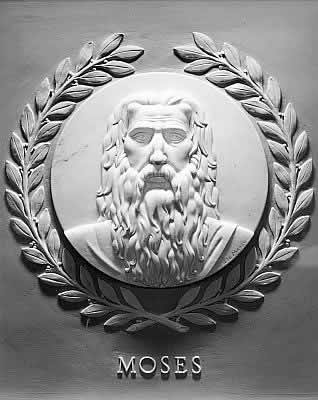
See Wikipedia
Monday, August 11, 2008
In God We Trust - Carved in Stone in the House of Representatives
If you visit Washington, D.C. and go to the House of Representatives, look above the Speaker's chair and you will see "In God We Trust" literally carved in stone:
Sunday, July 6, 2008
Jefferson Memorial Speaks of God
If you visit the Jefferson Memorial in Washington, D.C., look at the words inscribed inside the dome:
"for I have sworn upon the altar of god eternal hostility against every form of tyranny over the mind of man."
See Monticello.org
Monday, May 5, 2008
Washington Monument: Praise Be to God
Many who visit Washington, D.C. are not familiar with the fact that so many of our buildings and monuments have scripture on them. One of the best examples is the Washington Monument. It is the tallest structure in D.C. because it is mandated to be so. On the very top of the monument is the Latin phrase Laus Deo, which means "praise be to God."
Read more about the monument and the significance of its placement here:
Laus Deo!
Thursday, November 22, 2007
More "Signs" in Washington
Above the chair of the Speaker of the House is our official national motto, approved by the house and senate: "In God We Trust."
The Ten Commandments hang on the walls of the Supreme Court building.
Over the fireplace in the White House are the words placed by the first president to occupy that house, John Adams: "I pray heaven to bestow the best of blessings on this White House, and on all that shall hereafter inhabit it."
Tuesday, November 20, 2007
Monumental Evidence
Washington Monument
While legal proceedings are going on to eliminate a cross in a veterans' cemetary, and to forbid government employees from mentioning God during funeral services (and at most other ceremonies), there is a huge body of evidence in Washington, D.C. that our Founders did not fear such Biblical references.
The following words are inscribed inside the Washington Monument:
God and our native land. The memory of the just is blessed. Proverbs 10:7
Search the scriptures.
Holiness to the Lord.
Suffer the little children to come unto me and forbid them not for of such is the kingdom of God.
Train up a child in the way that he should go, and when he is old he will not depart from it.
In God we trust.
May Heaven to this union continue its beneficence.
At the peak is inscribed:
Praise be to God.
Monday, November 19, 2007
What Can You Read at the Library of Congress?
On the walls of the Library of Congress are many religious quotes, including: "What doth the Lord require of thee, but to do justly, and to love mercy, and to walk humble with thy God," and "One God, one element, and one far-off divine event, to which the whole creation moves."